
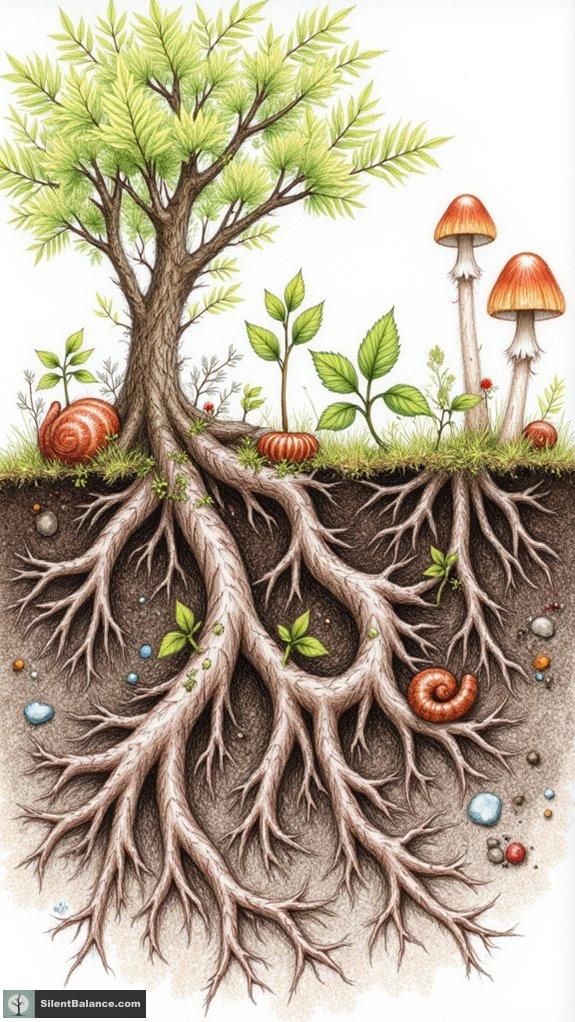
So, you’re curious about soil fungal networks and their future, huh? Well, you’re in for a treat! Picture investigating how different fungal species chat with each other—like buddies swapping ink secrets. Then there’s the role of non-mycorrhizal fungi in keeping ecosystems resilient, just like a tattoo artist maintaining a clean workspace. Plus, looking at how environmental stressors shake up these networks is vital. Stick around, and you’ll discover more about the cool tech helping us explore these fungal underground vibes!
Quick Takeaways
- Investigate the effects of environmental stressors on fungal network stability to predict ecosystem responses to climate change.
- Explore the role of non-mycorrhizal fungi in enhancing soil resilience and nutrient cycling during periods of drought.
- Utilize advanced imaging technology and machine learning to monitor and analyze fungal interactions and nutrient exchanges in real-time.
- Assess the impact of interspecies communication among fungi on agricultural productivity and pathogen resistance in diverse ecosystems.
- Develop conservation strategies based on fungal network data to protect biodiversity hotspots and enhance ecosystem integrity.
Investigating Inter-Species Communication Within Fungal Networks

When you think about the bond between different fungal species, it mightn’t be the first image that pops to mind, but it’s fascinating how these fungi have their own complex communication networks.
Picture this: fungi chatting with small peptides and volatile compounds, swapping signals like they’re at a block party!
They often fuse within their own species, yet they’ve got a knack for interspecies diplomacy too. Another species can influence their behavior—like a friendly neighbor borrowing sugar and turning up the vibe in the whole community. This interaction is facilitated by a conserved cell dialogue mechanism that allows one species to reprogram the behavior of another through signaling.
Ever wonder how they escape the drama of competition? Their signaling regulates growth and even traps nematodes, ensuring everyone knows their role in this underground social scene.
Isn’t nature just rad?
Understanding the Role of Non-mycorrhizal Fungi in Ecosystem Resilience

Non-mycorrhizal fungi mightn’t have the flashy reputation that mycorrhizal fungi do, but they pack a powerful punch in nurturing ecosystem resilience. These unsung heroes decompose complex organic matter, speeding up nutrient cycling like it’s a well-inked tattoo machine. Ever think about how they enhance soil structure? They’ve got the chops to retain nutrients, reducing leaching even when rain comes down hard. Plus, they meddle with microbial communities, influencing how plants absorb water and nutrients—pretty cool, right? Additionally, their interactions with bacteria can significantly enhance microbial resilience under challenging conditions like drought.
Assessing the Impact of Environmental Stressors on Network Dynamics
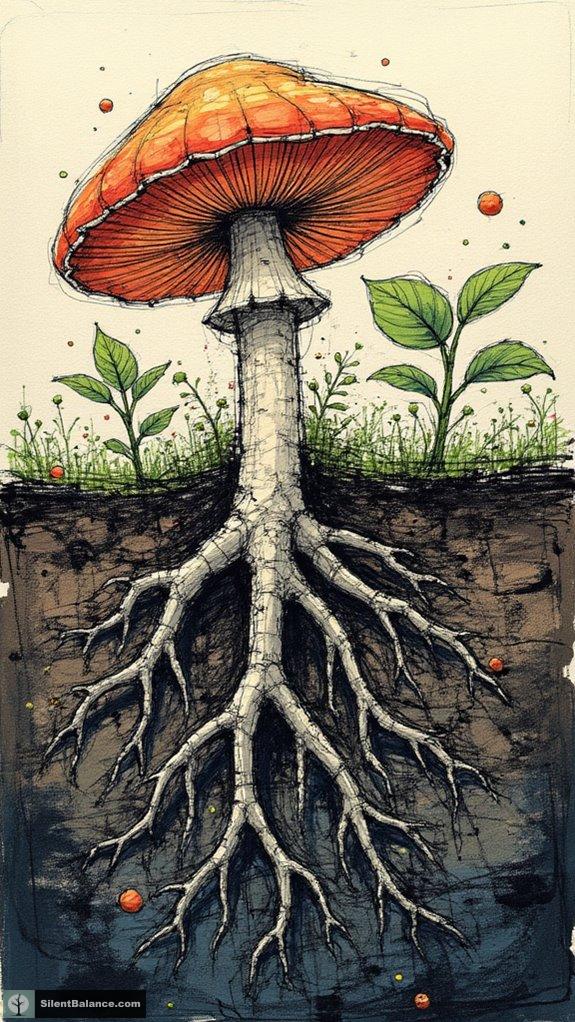
As environmental stressors crank up the heat in ecosystems, soil fungal networks feel the pressure too.
Ever noticed how increasing nitrogen or those heat waves mess with our fungal friends? Yeah, they’re not just chillin’ when temperatures rise; their diversity takes a hit, leading to less robustness in their networks. In fact, studies in the Tibetan Plateau show that mean annual temperature is a major driver of fungal diversity.
And drought? That’s a double whammy! With reduced moisture, mutualistic fungi struggle, turning crispy soil into a vulnerability hotspot.
You might ask, “What’s the fallout?” Well, think weaker interactions and an uptick in pesky plant pathogens.
These shifts threaten the stability of our ecosystems faster than bad ink can ruin a fresh tattoo.
Enhancing Conservation Strategies Through Fungal Network Data

Fungal networks, those complex underground communities, are often the unsung heroes of our ecosystems. Yet, they hold the key to enhancing conservation strategies that you may not have considered.
By leveraging fungal network data, you can:
- Identify essential biodiversity hotspots that need protection.
- Set clear restoration goals based on local fungal diversity and community complexity.
- Address urgent conservation gaps, especially since over 90% of these hotspots lie unprotected.
Incorporating this understanding into conservation efforts isn’t just smart—it’s critical. Healthy fungal networks contribute to greater agricultural productivity and pathogen resistance in plants, which underscores their relevance in preserving ecosystem integrity.
After all, without healthy fungal networks, we’re risking soil health and the overall ecosystem.
So why not mix it up and put fungi front and center, ensuring our world thrives underground?
Let’s pave the way for a healthy planet, one spore at a time.
Exploring Technological Innovations to Study Fungal Interactions

While you might think of fungi as just those squishy things on your pizza, they’re actually complex life forms forming dynamic networks beneath our feet.
Tech innovations like imaging robots are revolutionizing how we study these underground artists. These custom-built gadgets continuously monitor fungal activity, helping you track those nutrient trade routes that fungi adaptively navigate. Heck, they’ve compressed a century’s worth of manual data collection into just three years!
Machine learning swoops in too, analyzing billions of DNA sequences to map fungal networks globally. Envision understanding the secret lives of fungi without digging! Interestingly, these networks play a pivotal role in carbon flow regulation in ecosystems.
With these tools, you’re not just witnessing the flow of resources; you’re uncovering the resilience of these amazing organisms that keep our ecosystems thriving. Embrace that tech magic!
Mycorrhizal Networks and Soil Communication

When you step into a vibrant forest, don’t just admire the towering trees above—take a moment to appreciate the bustling underground hub of life that supports them.
Those mycorrhizal networks aren’t just fungal fashion statements; they’re complex communication systems.
Here’s what they do:
- They form bridges among roots, creating common mycorrhizal networks (CMNs) for sharing nutrients and stress signals.
- These networks allow plants to exchange defensive signals, prepping neighbors for incoming plant munchers.
- CMNs move essential nutrients like phosphorus and nitrogen, often giving young plants a much-needed boost.
- Interestingly, these networks also reveal a delicate balance between competition and cooperation in resource allocation among plants connected by mycorrhizae.
Future Research on Soil Fungal Communication Networks

Ever wondered what secrets lie beneath your feet, where the soil buzzes with life and chatter?
Soil fungi are like the underground storytellers, sending electrical impulses through their networks. These signals influence how fungi grow, adapt to nutrient needs, and even communicate in ways that resemble a primitive language.
Envision fungi acting like the skilled artists of a complex mural—each stroke, a message passed to plants, impacting everything from seedling growth to resilience against stress.
Future research could explore these connections further, uncovering the role of biochemical signals in ecosystem dynamics. By delving deeper into fungal communication, you’ll reveal how intertwined plant and fungal relationships shape our world, enhancing biodiversity and nutrient circulation.
Isn’t it thrilling to think of the vibrant life happening beneath the surface?
Questions and Answers
How Do Climate Change Effects Alter Fungal Network Functions?
Climate change messes with fungal networks like a bad tattoo artist with shaky hands.
As temps rise and drought kicks in, the scene shifts from hearty fungi to those weaklings that hardly connect. This weakens nutrient vibes for plants, leaving them starving.
It’s like replacing your favorite bar with a dive that serves stale beer. Without strong fungal networks, your soil’s health and carbon storage take a hit.
Who wants that, right? Let’s keep the vibe alive!
What Are the Socio-Economic Implications of Fungal Biodiversity Loss?
When fungal biodiversity takes a hit, you’re talking about a major economic bummer!
You lose earthy pals that help soil health, and suddenly, your crop yields drop, pushing prices up, right?
Plus, without those savvy fungi keeping pests in check, you might find yourself shelling out more for chemical sprays.
So, it’s not just about the fungi; it’s about your pocket too!
Who wants lower yields and empty wallets, am I right?
Can Artificial Intelligence Improve Fungal Diversity Mapping Accuracy?
With AI’s knack for processing data, it can totally enhance your understanding of fungal ecosystems.
Think about it—better classification and sharper perceptions mean healthier environments.
So, are you ready to let advanced tech help you dive deeper into fungal wonders?
Let’s embrace this blend of science and nature!
How Do Fungal Networks Interact With Other Soil Microorganisms?
Fungal networks don’t just chill solo; they vibe with bacteria in the soil.
Envision them as the cool graffiti artists in an urban environment, tagging alongside each other. Fungi form these complex highways, letting bacteria hitch a ride and spread their creativity.
This teamwork boosts nutrient cycling, keeps plants happy, and even fights off diseases.
What Role Do Fungal Networks Play in Agricultural Climate Resilience?
Fungal networks play an essential role in boosting agricultural climate resilience, my friend. They’re like nature’s underground support squad, helping plants survive heat, drought, and flooding.
Envision those mycorrhizal fungi as your plant’s bodyguards, enhancing water and nutrient uptake.
Sharing resources and nutrients through their mycelial web, they create a community that thrives even in tough conditions. How cool is that?
Protecting these fungal allies means better yields and a healthier planet, so let’s keep them thriving!
Summary
As we dive deeper into soil fungal networks, it’s clear there’s a whole world beneath our feet begging to be explored. Did you know that over 90% of land plants partner with mycorrhizal fungi? That’s a wild statistic! By understanding these networks, we not only improve ecosystem resilience but also bolster our conservation strategies. So, why not roll up your sleeves and get involved? The secrets of the soil await, and who wouldn’t want to be part of that adventure?
References
- https://engineering.princeton.edu/news/2025/02/26/hidden-fungal-webs-sustain-all-life-earth-revealed
- https://www.spun.earth/research/explainers
- https://news.nau.edu/fungal-networks/
- https://www.ecowatch.com/underground-fungi-networks-conservation.html
- https://fas.dartmouth.edu/news/2025/05/dartmouth-team-launches-public-database-soil-fungi
- https://www.pnas.org/doi/10.1073/pnas.2112518119
- https://pmc.ncbi.nlm.nih.gov/articles/PMC3180779/
- https://www.frontiersin.org/journals/fungal-biology/articles/10.3389/ffunb.2021.735299/full
- https://pmc.ncbi.nlm.nih.gov/articles/PMC4497361/
- https://www.nature.com/articles/s42003-025-08432-x
- https://pmc.ncbi.nlm.nih.gov/articles/PMC9666503/
- https://academic.oup.com/femsle/article/doi/10.1093/femsle/fnaf055/8169311
- https://pmc.ncbi.nlm.nih.gov/articles/PMC5697572/
- https://www.frontiersin.org/journals/environmental-science/articles/10.3389/fenvs.2022.888310/full
- https://besjournals.onlinelibrary.wiley.com/doi/full/10.1111/1365-2745.13521
- https://pmc.ncbi.nlm.nih.gov/articles/PMC12113623/
- https://pmc.ncbi.nlm.nih.gov/articles/PMC9886077/
- https://www.pnas.org/doi/10.1073/pnas.2221619120
- https://nph.onlinelibrary.wiley.com/doi/10.1111/nph.18308
- https://bmcmicrobiol.biomedcentral.com/articles/10.1186/s12866-025-04144-8

- Bonsai Placement Benefits for Room Harmony - November 8, 2025
- Why Use Air Layering to Propagate Bonsai Trees? - November 8, 2025
- 15 Stunning Acorn Wood Wall Art Ideas - November 8, 2025
