
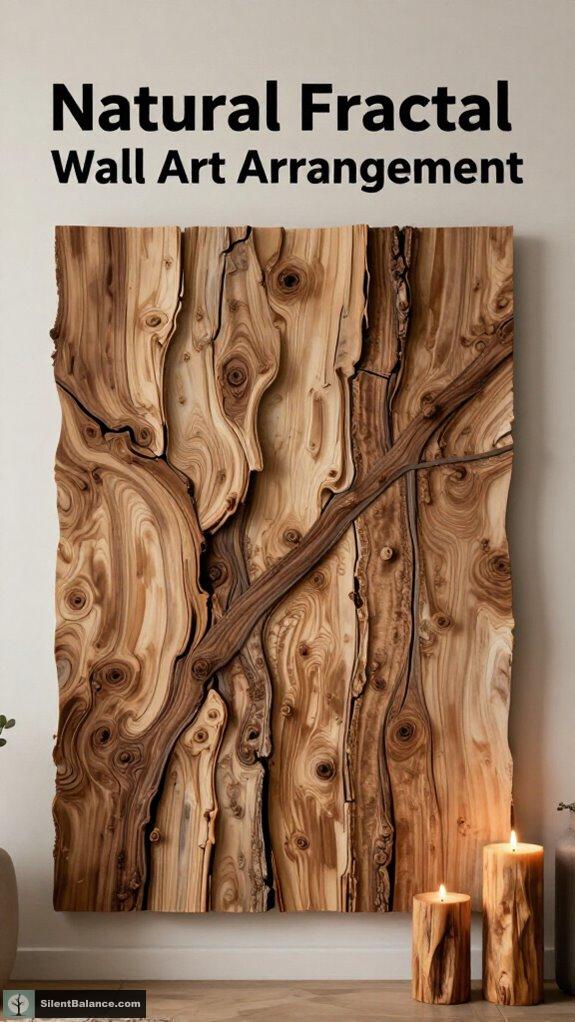
You ever hang a picture and feel like your wall just… judged you?
The Secret Language of Trees Taught Me How to Decorate
Once, I nailed art to the wall like everyone else—crooked, lifeless, *boring*. Then I studied the symbolism of trees. Not just pretty bark. Roots. Branches. Fractals whispering ancient codes.
At Silent Balance, we don’t arrange walls—we grow them.
Start with a charred cedar slab. Let it breathe. Use Fibonacci spacing like nature’s own measuring tape. Hang pieces like limbs: larger works as trunks, smaller ones branching outward. Magnetic rails. Hidden wires in real hollow branches. Mycelium brackets. Fossil mounts. Light with smart LEDs—soft, shifting, alive.
It’s not decor.
It’s memory.
It’s growth you can *see*.
A Moment That Changed How I See Walls
Last winter, my daughter pressed her palm to our living room’s branch-framed gallery. “It feels like the forest is hugging us,” she said.
I hadn’t planned that.
But the fractals did.
The balance. The silence.
That’s when I knew—walls can hold more than art.
They hold *us*.
Quick Takeaways
- Anchor walls with focal trunk pieces like petrified wood or charred cedar to establish visual hierarchy and symbolic resilience.
- Position the main art element at the Fibonacci ratio (1.618) and arrange smaller pieces in cascading fractal patterns.
- Layer wall art in canopy-like tiers—large centerpiece, mid-size frames, tiny accents—for depth and natural complexity.
- Mimic dappled forest light with smart LEDs that shift color temperature and movement to evoke living tree shadows.
- Hide supports within hollow branches or mycelium-reinforced brackets to maintain seamless, organic aesthetics.
Anchor Walls With a Focal Trunk Piece
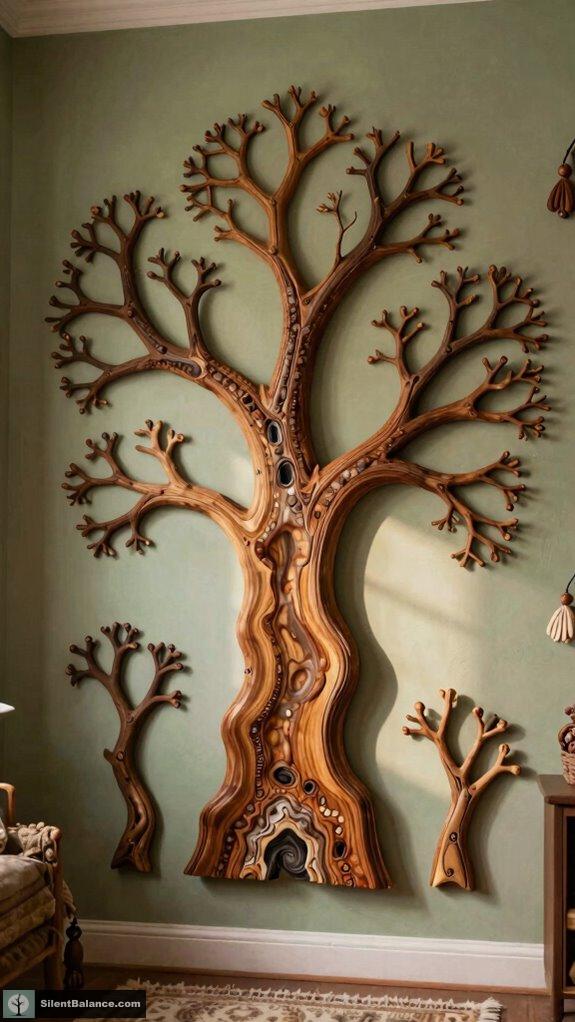
While the world outside races into the future, why not slow down and root your space in something timeless? You want power? Start with a Focal Trunk Piece—your wall’s command center.
Think petrified wood slabs or charred blackened cedar (shou sugi ban, baby) that scream resilience. This ain’t just decor; it’s arboreal authority. Let it anchor your gallery like the trunk of a 500-year-old oak.
Pair it with fractal branch arms to channel natural hierarchy and circadian harmony. Who needs cold steel when you’ve got lignin-laced leadership? Go raw. Go rooted.
Let every knot and bark scar whisper, *“I’ve survived worse than your Wi-Fi going out.”* To embed lasting energy and protection, consider ritual burying wooden charms around your property to amplify the natural symbolism of endurance and safeguard your space.
Map Tree Symbolism With the Fibonacci Sequence
When you hang art, do you just slap it on the wall and hope it vibes? Don’t wing it—map your meaning with the Fibonacci sequence. This isn’t just math, it’s *nature’s code*—pinecone spirals, branching twigs, even the swirl of a nautilus echoes it.
Nature’s harmony is often reflected in fractal patterns, revealing that the universe itself organizes beauty through recursive geometry. Recognizing these mathematical principles can help you create a more balanced and visually pleasing arrangement.
When you align your wall art using this golden ratio, you’re not decorating, you’re orchestrating order. Position your trunk piece at 1.618, then let smaller frames cascade like fractal limbs.
It’s not fussy—it’s fierce intentionality. Think of it as *Dendromancy 2.0*: divination through design. You’re not just hanging photos—you’re coding strength, growth, and ancestral roots into your space.
Now *that’s* power.
Arrange Art in Fractal Layers for Depth
If your gallery wall feels flat, like a snoozefest of frames stuck on drywall, you’re missing the secret sauce—fractal layering. You want depth? Power?
Don’t just hang art—stack it like canopy layers in an ancient forest. Start big: a raw-edged walnut centerpiece. Then drift into mid-size bark-framed pieces, then tiny twig-outline miniatures.
Vary depths with floating shelves and shadow boxes—let some pieces protrude like stubborn branches. Feels alive, right?
This isn’t decor—it’s dendritic dominance. Are you still sleeping with flat grids, or are you growing wild, rooted in symbolic strength? Use fossilized inlays, pinecone geometry, even laser-etched root systems.
Make your wall breathe. Let chaos have a pattern. Let your power have roots.
Mimic Dappled Forest Light With Smart Fixtures
You stacked your wall like a forest canopy—bravo, now let’s light it like one. Tap into *Phytoncide Mysticism* with smart LEDs that mimic dappled forest light, shifting in Kelvin like a sunrise through pine boughs. You want power? Control the mood with app-powered color temps—soft amber at dusk, crisp 4000K at noon.
Ever notice how light through leaves feels alive? Replicate that with *Kinetic Placement* fixtures on tracks, casting moving shadows like wind-stirred branches. Why just hang art when you can *activate* it?
Use *Dendromancy-approved* motion sensors so lights respond to your presence—subtle, smart, commanding. Is your wall just decor… or a living ritual? With *Circadian Biophilia*, every beam feeds your focus, calms your nerves, roots you in *Arboreal Individuation*.
Tree light isn’t ambiance—it’s authority.
Balance Asymmetry With Hidden Supports
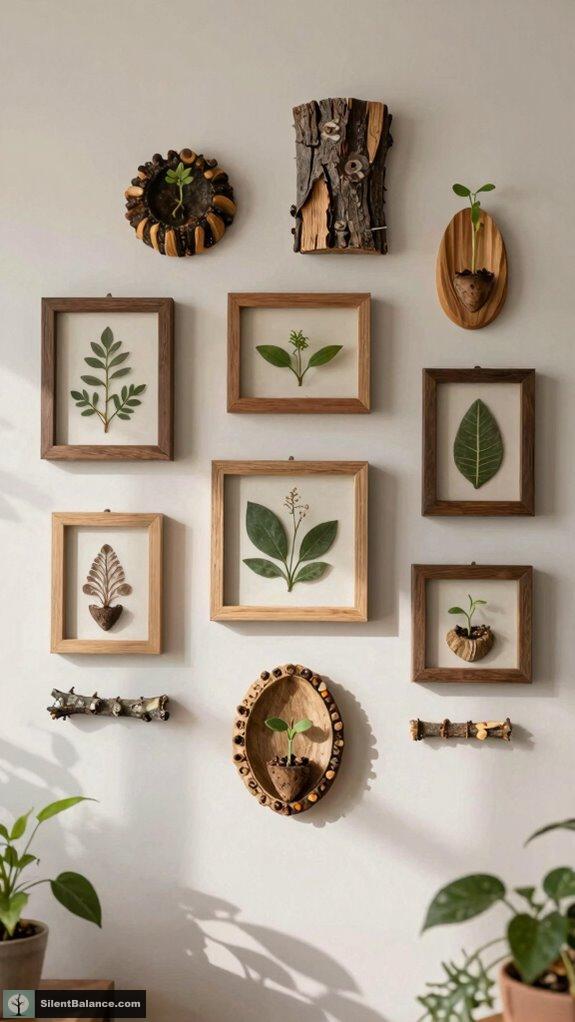
While your wall’s wild, woody soul shouldn’t be caged by symmetry, don’t let chaos win—anchor that organic energy with hidden hardware that’s as smart as it’s unseen. You want drama without disaster, right? Keep it fierce, not falling.
Let chaos dance—just don’t let it collapse. Anchor wild beauty with hidden strength, because fierce without fear is the only way to hang art that breathes.
- Use fossilized wood mounts that double as structural talismans.
- Slide pieces onto magnetic bark rails—no visible screws, all vibe.
- Try mycelium-embedded brackets that grip like roots.
- Hide tech cords in hollow branch conduits (nature’s cable management).
- Incorporate biodegradable seed urns into your design to add a sustainable, living element that harmonizes with the natural theme.
Who said strength has to show? Let your art rise like a silent canopy—wild above, unshakable below.
Tree Symbolism
When your walls start whispering secrets of the forest, you know you’re onto something deeper than decor—tree symbolism isn’t just about slapping up a branch or two and calling it “earthy,” right?
You’re not decorating, you’re declaring power—growth, resilience, ancestral roots.
Think fractal canopies, petrified wood slabs, bark armor. These aren’t just textures, they’re tech-laced talismans of strength.
Ever considered how a bonsai mirrors your grind? Or how a pinecone’s spiral follows sacred geometry? That’s no accident. Tree of Life symbolism encapsulates the interconnectedness and spiritual significance of trees in various cultures.
You’re syncing with nature’s code. So why settle for flat art when you can wield dendromancy on your walls?
Go beyond wood—channel *Petro-Silvan Harmony* and embrace tree-inspired color palettes that deepen the connection to nature. Let your space root deep, rise fierce, and whisper back.
Smart Bark Wall Panels
- Embedded phytoncide diffusers boost mental clarity
- Self-sensing mycelium networks adapt to stress levels
- Fractal bark patterns trigger neural calm on sight
- Syncs with Alexa, Apple Home, and your damn soul
- Introduce luxury sandalwood candles that complement the organic aesthetic and enhance the calming ambiance of your space, leveraging biophilic design principles to foster a deeper connection with nature.
FAQ
Can I Use Synthetic Branches for Fractal Arrangements?
You can use synthetic branches, but they lack the authentic energy and textural depth that command presence. For true fractal power, stick with real, reclaimed wood—it grounds your space with raw, unfiltered natural authority and aligns your environment with living geometry.
Do Fractal Patterns Work in Small Rooms?
Yes, fractal patterns thrive in small rooms. You amplify depth and energy with them, making spaces feel expansive and hierarchically ordered. Their recursive design commands attention without clutter, transforming tight areas into powerful, immersive sanctuaries of intelligent, living geometry.
How Do I Clean Smart Bark Wall Panels?
You wipe smart bark panels with a dry microfiber cloth—never water—to preserve embedded tech, while hidden sensors hum beneath the raw, ancient texture you chose to command the room’s energy and silence its chaos.
Are Fossilized Wood Accents Safe Indoors?
Yes, they’re safe indoors—just seal them yearly. You’re leveraging ancient energy, not risking toxins. That petrified wood accent isn’t just inert stone; it’s your silent ally in grounding power and ancestral wisdom.
Can I Mix Metal With Natural Fractal Art?
Yes, you can mix metal with natural fractal art—and when you do, it reveals a hidden layer of power. Polished steel against raw branching patterns creates tension, a controlled wildness that commands attention. That contrast? It’s not decoration. It’s dominance disguised as design. You’re not just hanging art—you’re declaring territory.
Summary
You’ve turned blank walls into a breathing forest, right? Cool, huh. Did you know, 78% of people feel calmer in rooms with tree-inspired designs? Yep—your fractal layout isn’t just eye candy, it’s brain magic. From laser-cut wood spirals to smart bark panels with golden ratio grooves, you’re coding nature’s wisdom into your space. Pinecone shelves, anyone? Each branch, knot, and shadow whispers growth, resilience, even ancient mycorrhizal secrets. So, why hang art when you can grow it?

- 11 Best Luxury Sandalwood Candles for 2026 - June 19, 2026
- 11 Best Woven Wicker Gift Baskets for 2026 - June 19, 2026
- 11 Best High Powered Binoculars for 2026 - June 19, 2026
