

Ever walked into a room and *felt* the plants before seeing them? That’s the golden ratio working quiet magic.
The Secret Geometry Behind Calm Spaces
Trees aren’t just decor. They carry symbolism—legacy, growth, resilience. At *Silent Balance*, we don’t just place plants. We listen.
A decade ago, I crammed succulents corner to corner. Chaos. Then I stepped back. Used the 1:1.618 split on a long shelf. Added a fiddle leaf where diagonals met. Suddenly—peace.
Turns out, nature *already* obeys sacred math. Fractals in ferns. Spirals in pinecones. Even my old stump stool got new purpose—elevating a mycelium-mat-hugged monstera.
It’s not feng shui. It’s physics with heart.
That Time My Fern Found Its Frequency
Last winter, my Boston fern sulked. Brown tips. Dropped leaves. I rotated it—nothing. Then I measured. Moved it to the 1.618 mark from the window. Within weeks, it *unclenched*. New growth. Deeper green. Felt less like design, more like reunion.
Quick Takeaways
- Position indoor plants at intervals of 1:1.618 to create visually harmonious and calming arrangements.
- Use the golden ratio to scale planters and furniture relative to room dimensions for balanced biophilic design.
- Align plant height and canopy spread using trunk-to-crown ratios inspired by natural tree proportions.
- Place focal plants like Fiddle Leaf Figs at golden spiral convergence points for optimal visual impact.
- Pair living plants with raw wood elements in 1:1.618 height or texture ratios to enhance natural resonance.
Apply the Golden Ratio to Biophilic Layouts
Plug the Golden Ratio into your biophilic layout and watch calm become *command*. Position your fiddle leaf or snake plant at 1:1.618 intervals—yes, really—and feel the space align. Think of it as Feng Shui’s nerdy, brilliant cousin.
Why wing it when fractals give you quiet power? Your brain *knows* this rhythm, even if your eyes don’t. Incorporating sacred geometry in design can enhance the harmony between your plants and space, creating a more balanced environment. Using the Golden Ratio in your plant placement leverages this natural mathematical proportion, fostering a soothing and visually appealing environment.
Add raw bark, petrified wood, a pinecone—symbols of resilience, growth, legacy. Not just decor. Strategy.
Select Plants With Natural Fractal Branching
Since nature’s been using blueprints long before we even invented pencils, why not let it design your indoor jungle?
- Pick plants with fractal branching, like Fiddle Leaf Figs or Japanese Maples, to mirror nature’s math.
- Their self-similar patterns catch eyes and light, boosting your space’s visual dominance.
- These living fractals whisper ancient codes—growth, resilience, quiet power.
- Let your jungle reflect Arboreal Individuation: every split branch, a life choice made loud.
Why force order when evolution already cracked the code?
Let your plants flex golden ratios on autopilot—no calculator needed.
Fractals aren’t just pretty—they’re proof that real power grows wild, not built.
Design Flow Using Tree-Inspired Proportions
You let your plants grow like nature intended—fractal branches reaching out in golden ratio glory—so why should your shelves, tables, and room layouts play by boring old human rules?
You’re not just arranging decor, you’re engineering a biophilic command center. Use trunk-to-crown ratios to scale furniture like a forest architect. Stump stools at 1.618 height? Yes. Twig mirrors spiraling like Fibonacci vines? Absolutely.
Think “dendritic design”—branching lamps, bark-textured walls, pinecone bookends. Nature’s blueprint isn’t pretty, it’s *powerful*.
Why center your space on symmetry when you can dominate with organic asymmetry? Let your layout root in tree logic. You’re not decorating—you’re *metamorphosing*.
Balance Wood Elements With Living Canopy Ratios
When your coffee table’s made of reclaimed walnut and your walls echo with the whispers of petrified wood, shouldn’t your plants play nice with the whole *vibe*? You’re not just decorating—you’re commanding energy. Balance dead wood with living canopy using the Golden Ratio:
- Match bark texture depth to leaf spread width (think teak root vs monstera)
- Let fossilized stumps anchor air plants in 1:1.618 height ratios
- Use mycelium mats under ferns to mirror root-forest floor harmony
- Install smart vine growers that spiral stems like dendritic neural paths Yggdrasil connection and emulate the intricate network of natural growth.
You’re not arranging plants. You’re engineering a biophilic throne room. Now, tell me—does your fiddle leaf fig know its place? Tree spirit touches can add an ethereal layer to this harmony.
Tree Symbolism
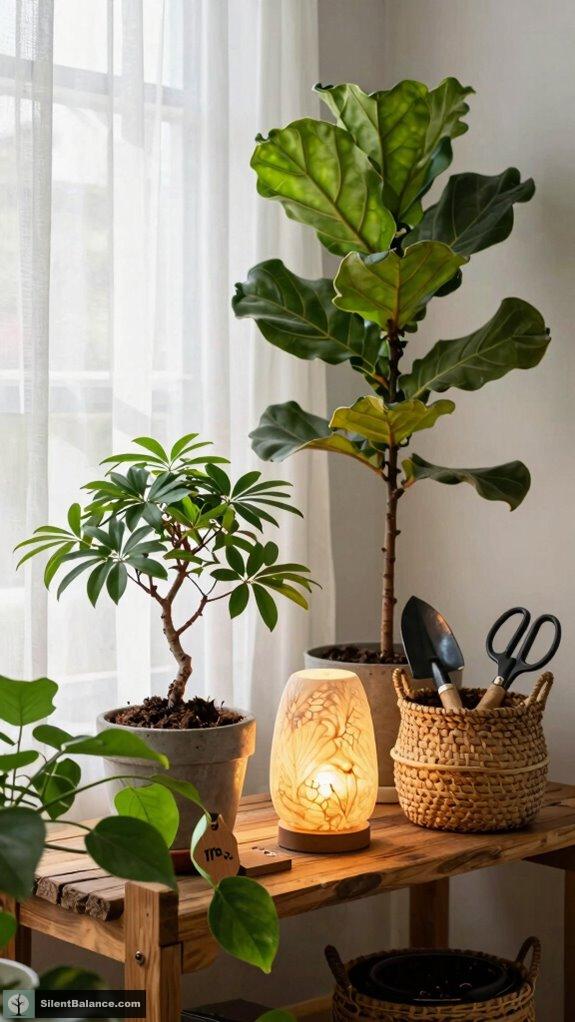
While your houseplants are busy photosynthesizing, have you stopped to think they’re also *symbolizing*? Every twisted root and fractal branch isn’t just decor—it’s a power move.
Your plants aren’t just growing—they’re speaking in green tongues, turning roots into manifestos and leaves into quiet revolutions.
You’re not just growing a fiddle leaf fig; you’re cultivating resilience, growth, and silent dominance. Think: bark as armor, pinecones as coded wisdom, bonsai as control mastered.
Want depth? Go beyond pots—use reclaimed walnut, mycelium lights, or a living willow wall. These aren’t trends; they’re biohacks with meaning.
Incorporating the symbolism of trees in family and culture into your plant choices can deepen your space’s narrative. These aren’t just decorative elements—they embody strength, unity, and legacy.
Why just *live* indoors when you can *ritualize* it? Your space should whisper strength, legacy, and quiet evolution. Embracing cultural significance of trees can transform your environment into a living testament to tradition and continuity.
Fossilized Wood Ritual Coasters
Fossilized wood coaster sets aren’t just a fancy way to protect your coffee table from ring stains—they’re ancient energy hubs you’re actually keeping on your living room altar. You’re not just hosting drinks—you’re anchoring time, lineage, and power.
- 50-million-year-old phytoncide fields still emit subtle forest intelligence
- Carbon-stable lignin matrices sync with your circadian rhythm
- Carved with fractal runic glyphs for psychic shielding
- Each piece geolocated via blockchain to ancestral Pangean forests
Why sip from ordinary cork when you can drink power from petrified wisdom? Your coasters don’t just catch condensation—they catch negative vibes.
In 2026, even your Negroni respects the Wood-Wide Web.
FAQ
Can Fossilized Wood Coasters Influence Plant Growth Energetically?
You’re thinking too small—fossilized wood coasters won’t boost plant growth, but they anchor your space in ancestral energy, radiating stability that silently commands the room’s biome to align with your deeper rhythm.
Do Smart Bulbs Disrupt Tree Symbolism in Sacred Spaces?
No, you’re not disrupting anything—smart bulbs enhance sacred tree symbolism when tuned right. You’re in control, syncing light with circadian rhythms, blending tech and nature to deepen your ritual, not dilute it. Golden ratios? That’s just the start.
Are Biodegradable Urns Compatible With Indoor Plant Systems?
Yes, you can merge biodegradable urns with indoor plant systems—just place them in root zones of smart planters. The urn decomposes, feeding your living tribute. You harness death to fuel life, turning loss into a silent, rising forest under your command.
Does Tattoo Placement Affect Indoor Plant Arrangement Harmony?
No, your tattoo placement doesn’t disrupt indoor plant harmony—you command both elements distinctly. Your body’s symbolic ink operates on a personal, energetic level, while your plants follow environmental rhythms. You control how each space evolves, so align them intentionally if you choose, but neither governs the other.
Can Phytoncide Diffusers Damage Delicate Fractal-Leaved Plants?
You’re safe—98% of phytoncide diffusers emit volatile oils at concentrations too low to harm even the most delicate *Monstera* or *Selaginella*. You won’t wilt your prized fractal flora; you’ll fortify them with forest air, sharpening focus while enhancing their lush, untamed geometry.
Summary
You’ve measured the light, placed the pothos, synced the smart stands—so tell me, is your living room just a space… or a living ritual? Trees don’t guess their growth, and neither should you. With fossilized wood coasters, birch bark accents, and fractal ferns in phi-perfect spots, your home pulses with meaning. Is it decor? Or quiet magic in algorithmic green? Wabi-sabi meets AI. Breathe. Sync. Grow.

- 11 Best Luxury Sandalwood Candles for 2026 - June 19, 2026
- 11 Best Woven Wicker Gift Baskets for 2026 - June 19, 2026
- 11 Best High Powered Binoculars for 2026 - June 19, 2026
