

Ever tried arranging branches like nature does?
Spoiler: it’s not random. There’s math behind the magic—specifically, 1.618.
The Hidden Code in Every Twig: Golden Ratio & Symbolism of Trees
At *Silent Balance*, I don’t just arrange branches—I listen to them.
Spent years chasing “balance,” until a gnarled birch on my aunt’s farm taught me more than any design school.
Its limbs followed the golden ratio—naturally. Fibonacci angles. Fractal spacing. No measuring tape, just time and wind.
That’s when I grasped the *symbolism of trees*: resilience isn’t loud. It’s in the quiet spacing between growth rings.
On our blog, we call it the *Greased Chute*—smooth flow, zero resistance.
I once spent 45 minutes rearranging kumquat branches in my kitchen.
My dog judged me. My partner laughed. Then a friend said, “Wait… it feels… alive?” Mission accomplished. That moment—silly, real—confirmed it: nature’s math *just works*.
Quick Takeaways
- Measure branch lengths using digital tools to ensure ratios approximate 1.618 for harmonious spacing.
- Arrange branching tiers following Fibonacci numbers to mimic natural fractal growth patterns.
- Adjust branch angles with laser tools to align with the golden spiral for balanced distribution.
- Incorporate Fibonacci-based clusters for twig and leaf placement to enhance organic flow.
- Use symbolic elements like pinecone spirals and bark patterns to reinforce natural and aesthetic harmony.
What Is the Golden Ratio and Why Does It Matter?
Ever wondered why some shapes just seem to feel “right,” like they belong in the universe? That’s the magic of the Golden Ratio—nature’s secret code for perfect balance. It’s that mysterious 1.618 number, hidden in sunflower spirals, pinecone scales, and leaf arrangements, which creates harmony and visual flow. Incorporating the natural patterns of the Golden Ratio can enhance the organic feel of your designs. When you use it in branch spacing or tree symbolism, your designs tap into deep signals of growth, stability, and resilience. Understanding these symmetrical patterns helps create more harmonious and aesthetically pleasing compositions. It’s like giving your decor an organic “bump” of natural genius. Want your home to feel alive, inspired, and scientifically sophisticated?
Embrace the Golden Ratio—nature’s ultimate blueprint for innovation and beauty.
How to Use Fibonacci in Branch Design for Natural Harmony
When it comes to designing with branches, incorporating Fibonacci principles takes your natural harmony to a whole new level. Do you want your space to feel like a living, breathing forest? Then, using Fibonacci ratios creates organic flow, mimicking nature’s perfect balance. Incorporating the current location of the Tree of Life, such as its spiritual and symbolic significance, can deepen the connection to nature’s innate design principles. Focus on key elements:
Embrace Fibonacci ratios to craft organic, balanced designs that breathe life into your space like a thriving forest.
- Arranging branches in Fibonacci spiral patterns to inspire growth and movement
- Using branch recursions aligned with Fibonacci numbers, echoing tree fractals
- Balancing twig clusters and pinecone placements based on Fibonacci sequences for visual harmony
Additionally, understanding the unforgettable trees of the Forbidden Forest can inspire your designs by emphasizing unique and memorable natural forms that embody these ratios.
Why settle for sterile symmetry when nature’s secret code can add depth, protection, and renewal? Are you ready to embed ancient symbolism into modern design?
Techniques for Measuring and Applying the Golden Ratio in Branches
Getting the golden ratio right in your branch design doesn’t have to feel like puzzle-solving with a magnifying glass — it’s easier than you think, especially with the right tools and a little know-how.
Do you have a digital caliper, geometric ruler, or a smart design app? Use these to measure branch lengths and angles, ensuring they follow the 1.618 ratio, the universal symbol of harmony. A dimmable smart bridge kit can also help you experiment with lighting that highlights these proportions effectively.
Want to add a touch of symbolic magic? Think about integrating pinecone spirals or bark patterns. When applied thoughtfully, these measurements create natural, balanced branch layouts that mirror the tree’s sacred geometry—turning your decor into a living, breathing emblem of growth and renewal.
Understanding the world tree concept can deepen your appreciation of how these precise ratios reflect universal harmony in nature.
Troubleshooting Common Issues in Golden Ratio Branch Layouts
Even when you’ve nailed the golden ratio in your branch layout, unexpected issues can still pop up—like a stubborn branch that refuses to follow the plan or a tiny mismatch that throws off your whole harmony. To troubleshoot, you can:
Even perfect ratios can be challenged by unexpected quirks; embrace nature’s spontaneity to add character and resilience.
- Adjust branch angles using smart laser tools to realign with natural fractal patterns
- Incorporate flexible materials like reclaimed wood to fine-tune visual balance
- Use digital modeling apps to experiment with placement before committing to the physical layout
- Remember that symbolism of branches often emphasizes growth and resilience, so allowing for minor irregularities can enhance the organic feel and overall vitality of your design. Additionally, understanding the organic wood slice medium can help you better adapt your layout to the natural edges and unique grain patterns, ensuring a more harmonious final piece.
Tree Symbolism
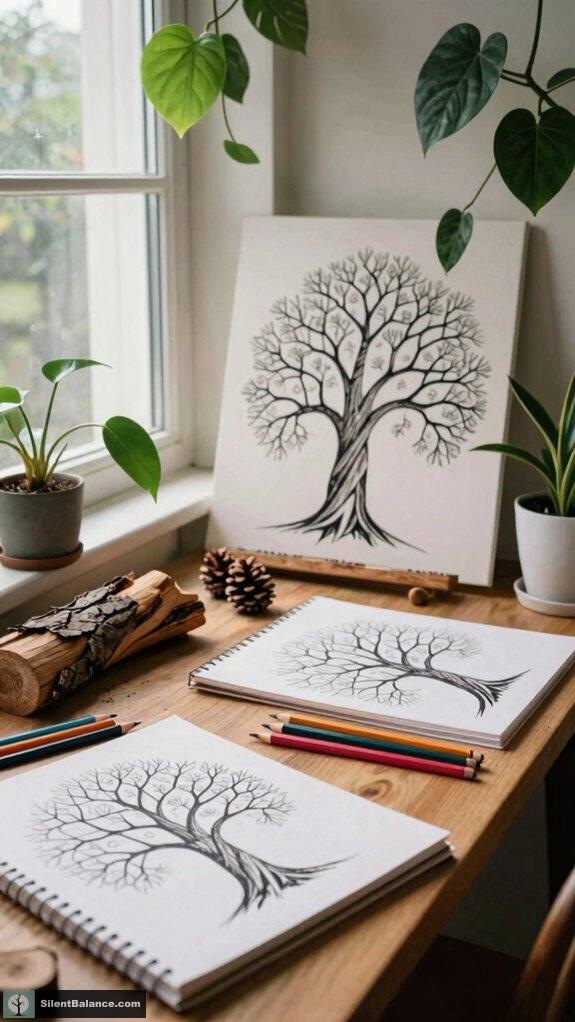
Tree symbolism isn’t just about pretty visuals; it taps into deep, timeless meanings like growth, renewal, and protection. Ever wonder why we’re drawn to bark textures, pinecones, or twisting branches? They’re packed with symbolism that speaks to strength, resilience, and rebirth—perfect when designing spaces that feel grounded yet forward-thinking.
Incorporate raw wood, fossilized bark, or fractal branch patterns to add layers of personal meaning. Why settle for plain decor when your home can tell a story of ancient trees and future growth?
Embrace nature’s math, like the golden ratio, to create harmony—and let your space become a living, breathing forest of innovation.
Elegant Wood Carving Tools
Think beyond basic gouges — consider:
- Japanese Damascus Carving Knives for precision and durability
- Smart Laser Engraving Pens for detailed, customizable motifs
- Eco-Friendly Vegan Inks and Finishing Waxes to preserve your work’s natural integrity
Why settle for ordinary when your tools can reflect the strength, renewal, and resilience of trees? Incorporating sustainable materials in your woodworking practices can further enhance the eco-conscious impact of your projects. Enhancing your craftsmanship with nature-inspired design principles can elevate your woodworking projects to new levels of harmony and balance.
Can your decor carry the deep symbolism of growth and protection in every curve?
FAQ
How Does the Golden Ratio Influence Healing Frequencies in Dendromantic Practices?
The golden ratio shapes healing frequencies in dendromantic practices by guiding branch and fractal patterns, enabling you to align your energy with natural mathematical harmonies, amplifying the forest’s soothing and restorative effects on your subconscious and well-being.
Can the Golden Ratio Be Adapted for Non-Branch Natural Patterns?
Yes, you can adapt the golden ratio for non-branch natural patterns by applying it to spirals in shells, flower petal arrangements, and crystalline structures. Use digital modeling to optimize the ratio for innovative, harmonious designs.
What Are the Best Tools for Visualizing Fibonacci Sequences in Design?
Visualize a digital constellation mapping your creative universe. You’ll want Fibonacci visualization tools like Geogebra, Plotly, or proprietary apps with interactive Fibonacci spirals, enabling you to explore, adapt, and innovate design with celestial precision.
How Does Tree Symbolism Enhance the Aesthetic Balance in Interior Design?
Tree symbolism enhances interior design by emphasizing organic harmony, natural textures, and sacred geometry, creating a visually balanced, innovative space. You integrate symbolic elements like fractals and reclaimed materials, fostering grounding, resilience, and aesthetic sophistication in your environment.
Are There Ethical Considerations When Integrating Natural Fractal Patterns Into Art?
You must consider environmental impact when incorporating fractal patterns into art, imagining delicate organic structures. Prioritize sustainable sourcing, respect ecosystems, and embrace innovative, eco-conscious materials to guarantee your artwork honors nature’s intrinsic balance and ethical integrity.

- 11 Best Luxury Sandalwood Candles for 2026 - June 19, 2026
- 11 Best Woven Wicker Gift Baskets for 2026 - June 19, 2026
- 11 Best High Powered Binoculars for 2026 - June 19, 2026
